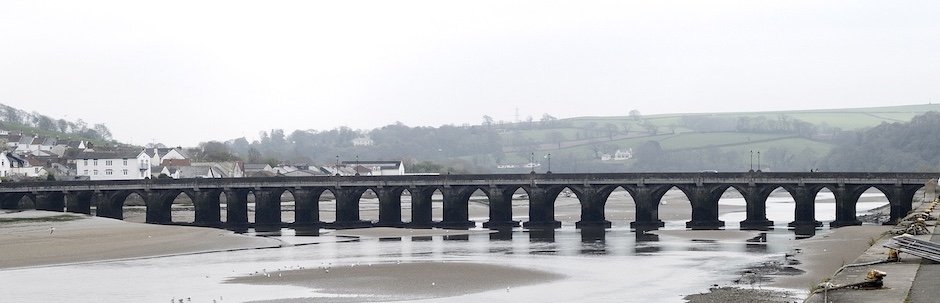
Bideford ship building
No one watching the Torridge silting its dreamy way through Bideford today can imagine the hives of activity on each bank during the 18th and 19th centuries. From 1760 to 1899, forty builders of ocean going vessels had slips and yards between the old ford (above bridge) and the Skern at Appledore. From 1760 to 1820, over three hundred vessels were launched. They included 12-gun sloops, fire ships, survey vessels and 530 ton ‘sixth-raters’ for the Royal Navy. For comparison, the Kathleen and May was rated at 136 tons and the Oldenburg is 327. Bideford ships were like Appledore men – if a captain saw a man wearing an knew he was a ‘good un’ and the same applied to Bideford ships. A 30 tonner – the size of the trawlers you see alongside the quay today – sailed to New Zealand on its maiden voyage without mishap.
Between 1805 and 1814 Richard Chapman at his Cleave House slip built seven ships for the Royal Navy, four of ‘sixth-rate’, the first being the 118 foot ‘Garland ‘(of the Laurel or Henslow Class), carrying twenty-two 9-pound guns on the upper deck. However, captains often carried more guns than the official rating. Hardy had two 64-pounders on the quarter deck of Victory. The ‘Garland’ carried six 24-pounders on her quarter deck, two more on her forecastle and two 16-pound, long barrelled ‘chasers’. Garland‘s full crew, if available, was 155 officers and men. She was ordered in 1805, her keel laid in 1806, and launched on 2 October 1807. Unfortunately, like other ships surplus to requirement after the Napoleonic wars, she was broken up in 1818.
Richard Chapman also built ships of the Rosamond Class – copies of a French design. After the outbreak of the Napoleonic wars it became obvious that French ships were better designed and faster than our own.
Consequently, a captured French ship was not only much appreciated – it was often physically measured and copied.
Another builder for the Royal Navy was William Taylor of Cross Park, whose slip was at the north end of the quay, East the Water. He built at least one ‘Thai’ Class fire-ship, the ‘Comet.’ Length 108 feet, 9 inches, she was within a few feet of the Kathleen and May’s measurements. She was ordered in 1805, her keel laid in 1806, and launched on 25 April 1807. In 1808 she was reclassified as a sixth-rate sloop and sold in 1815. Fireships were not just any old disposable vessels but purpose built.
However, before going for their ultimate use, they carried numerous guns. ‘Comet’ carried sixteen 24-pounders or 32-pounders on the upper deck, two 9-pounders and eight 18-pounders on the spar deck and two 9-pounders on the forecastle. However, a large portion of what one thinks of as cargo space consisted of tall, vertical boxes that would act as chimneys when primed with combustible material. It took considerable skill and courage to sail what was to become a blazing bomb close enough to the enemy to be effective. The ship’s crew was about fifty but, on the fateful day, most were taken off leaving a skeleton crew, including the captain, to sail as close to the enemy as possible before escaping from the blazing vessel by rowing boat.
Sadly, there is no material or publicity of any kind that justly tells how great a port Bideford was. It seems inevitable that Bideford will eventually silt up as badly as Barnstaple. Then, not even the clay ships will be able to dock in what was once the third busiest port in England. But who cares?
[Postscript Mar 02]
The Fate Of The Carnation, 3rd October 1808: Another ship built by William Taylor of Bideford was the 18 gun Brig Sloop – “Carnation”. Of 382 tons she was one of the most numerous type of warship in the age of sail. Unfortunately, having been launched on the 3rd October 1807, she was captured by the French exactly one year later.
To Elizabeth Brooks seeking information on a ship called Rochester She was built by Richard Chapman in his Cleave houses yard in Bideford as HMS Volage She was a 6th rate warship of 545 tons launched in 1807 it appears that in 1818 she was sold out of service and became a merchant ship named Rochester she made her first commercial voyage between England and India and then made further voyages to the South Seas as a whaler, she was last listed in Lloyds register in 1831
Hi Richard Banfield,
I too am very interested in the schooner “Vivid” as one of my ancestors, Richard Grenfell was captain/Master onboard when the Vivid was caught in a gale sailing from Newport to Barnstaple and was wrecked in 1877. All they found were bits of wreckage. It’s believed Richard Grenfell and his son Richard jnr age 21 were drowned at sea.
Richard Grenfell was the son of John Grenfell and my Eleanor McDonald of St. Ives, Cornwall.
I would love to hear from you as your surname has popped up in relation to my McDonald family of St. Ives and Falmouth, Cornwall.
Marj Winter Sydney, Australia.
I have been told that my ancestors were shipwrights and came from Bideford. From there they emigrated to South Africa; this would have been in the early 1700s. My family have got lots of information from there but are stumped at this end. Can anyone throw any light on this? The Family name was Bartlett, the head of the family was William Henry Bartlett – he was widowed when he went to Africa as a Shipwright.
Hi everybody,
I am looking for information on the Rochester which used to sail to and from Calcutta in the early 1800. My great great …. sailed on her under Commander David Sutton and was discharged on 7th August 1820 . I believe this ship was built in Biddeford in 1807, was a 545 tons and was owned by A. Hill .
Could anyone give further information as I am struggling with my family tree.
I thank you in advance for any information you may be able to give me . All the best !
Hello:
I am trying to research, Richard Chapman who built ships in Devon in the 1600s before leaving for America. His son or grandson also a Richard Chapman built ships in the Albemarle, Tyrell County around the 1800s before leaving for Illinois.
It may be that the Richard Chapman here is my relative. My cousin, Inglis Fletcher visited the area and said she found the shipyard. I am trying to factually verify this information.
Thank you.
I im looking for information of a fishing smack NEW ZEALAND, abt 85 tons gross and 60 tons net, built 1877 in Bideford.
Unknown year sold to Norway and in 1904 sold to Sweden.
I can however not find her in CLIP under this name, and thus not know her Official Number.
I am seeking further information on the schooner “Flora”, built in 1852 at Bideford. She was 128 tons old measurement and 98 tons new measurement, 74 feet long, and, from 1852 to 1857 owned by T. Evans. In about 1856/7 she changed hands and was owned by James Phillips of Scilly, until her loss in 1869. Her captain during this period was first, S. Wallis , and later, T. Oates.
I have more details on the vessel and am willing to share these with anyone interested.
Regards,
Roger Banfield, Isles of Scilly.
Try the North Devon Maritime Museum at Appledore. They have research facilities ([email protected]). Bideford was the registration port for the area which covered ships built at Appledore in the 1800’s. At that time there were lots of small shipbuilders/boat builders along the banks of the River Torridge from Appledore to Bideford and even further up the River to the beginning of the Rolle Canal near Weare Gifford.
Hi,
I’m researching a schooner built in 1851, at Bideford, which was registered and sailed from Scilly between 1851 and 1860. It was then sold on to new owners at Whitehaven.
The details I have are as follows:-
Name: “Vivid”
Built: 1851
Type: Schooner
Dimensions: Length: 81.0 ft. Beam: 20.1 ft. Depth of Hold: 13.1 ft.
Tonnage: 131 tons (12years A1)
Builder: Bideford
Owners: 1852 – 1860, Lebrey & Co (.Possibly Ann Banfield)
1861 – 1869, Possibly W. Nicholson
Captains: 1852 – 1860, E. Lebrey
1851 – 1853, Lakey (possibly Edmund b. 1821)
1861 – 1869, Possibly N. Beck
1863, Britton
Trade: Bideford, Mediterranean, Scilly, New York, Palermo, Bristol, Cardiff, Falmouth, Hamburg, Antwerp, Marseilles, Smyrna, Jamaica, London, Holyhead, Whitehaven, Dublin, Pomaron, Gloucester, Belfast, Liverpool, Messina,
Cargo: 1852, Coffee
1863, Oil.
1864, Iron ore.
Port of Registry: 1852 – 1860, Scilly
1861 – 1869, Whitehaven
Port of Survey: 1854 – 1860, Bideford
1861 – 1869, Whitehaven
Signal: K.G.S.B.
Official No.: 9301
Crew:
Demise: Possibly after 1870
Would you have any details of the builder, or can you put me in touch with someone who could help.
Roger Banfield, Isles of Scilly
national maritime museum book title SHIPBUILDING IN NORTH DEVON .Maritime Monographs and reports No22 -1976. List of all ships built on Taw and Torridge and their builders from 1725 -1979.
I have in the past week heard about Henry James Bath of Swansea Owner of a large fleet of vessels said to be built in Bideford He used names from the Greek alphabet for several eg Gamma and Delta. His ZETA was built in Scotland and Captained by the G Grandfather of Catherine Zeta Jones !!
My direct line is from the Clibbett ship builders of Appledore and I am wondering if the name bideford would have covers Appledore ca 1830-1870.Where can I check builders if I have the name of the Vessel .I do have a great deal of info re the Clibbetts,
Richard b 1838 was the g grandfather of Jeffrey Archer 100%